
As MPs return to Parliament, what is the public and political mood on the environment?
By Matthew Dawson, Senior Account Manager
With MPs returning last week from their Christmas recess, the latest opinion polls paint a stark picture of a frustrated and divided nation, with environmental issues fighting for attention.
Last year saw Government policy progress on several environmental issues but also widespread delays and fights over planning reforms. Now, decisions on oil and gas, including the imminent call on the Rosebank field, and further planning deregulation risk sparking a fresh backlash from environmental groups.
With the Labour Government still holding a huge majority, and a General Election not expected until 2029, to influence policy organisations will need a clear appreciation of the forces shaping ministers’ room for manoeuvre.
A fractured electorate
As recently as the 2017 General Election, the combined vote share of the Conservatives and Labour, the two historically established parties of Government, was 82%. Today, the picture could not be more different, with the two parties combined commanding a mere 36% of the vote in the latest polls.
According to YouGov’s latest voting intention polling, it’s Reform UK who are leading at 26%, followed by the Conservatives at 19%, now overtaking Labour who sit in third place at 17% - with the Lib Dems slightly behind at 16% and the Greens at 15%. This means the ‘progressive’ block of voters (Lab/Lib Dem/Green) stands at 48%, and the ‘right wing’ block (Con/Reform) stands at 45%.
Divided politics means that smaller parties are increasingly dominating media attention and influencing political decisions.
Reform UK
It is worth paying attention to Reform’s emerging environmental policy positions, particularly on clean energy, as the party looks to convert strong national polling into local power in May.
Reform’s immediate-term focus is a targeted local election campaign – in the run up to the local elections Reform will be focusing on policies and issues angled towards Scotland, Wales, London and local authorities. Reform are particularly hopeful about councils in outer London where Boris Johnson performed well during his Mayoral tenure.
Expect plenty of bluster, along the lines of Greater Lincolnshire mayor Dame Andrea Jenkyns last year comparing the fight against green energy to that of Bomber Command, which was based in the county during World War Two. However, when assessing real world jobs and investment, it will be interesting to see how many Reform local leaders echo the Reform Mayor of Hull and East Yorkshire Luke Campbell, who said he is "all for" cleaner air and green energy.
Following elections in May, we expect a total national policy refresh, with Reform planning to launch a new set of policies with a stated view of being ready to govern at the next General Election. The 2029 manifesto will not resemble that of the 2024 election; developed before Nigel Farage returned to Reform UK.
Continued challenges for the Government
Meanwhile, Ipsos reports that public pessimism about the state of Britain continues with 71% saying Britain is heading in the wrong direction and just 12% saying the right direction. Ipsos state that this is the first time since they have run this poll, over a period since January 2020, that more than seven in ten have said the ‘wrong direction’.
Britons continue to say that, when rating the top three issues facing the country, the economy, immigration and health are top by a clear margin. Over the course of the year, YouGov found that the percentage of people rating the environment in the top three has remained relatively stable, only falling from 17% to 14%, see below (it’s worth noting that on a different metric Ipsos find that 51% of adults report climate change and the environment as an ‘important issue’). With the Government looking for popular policies which address these top public concerns, it is essential to consider how your business or campaign might help to address these issues.
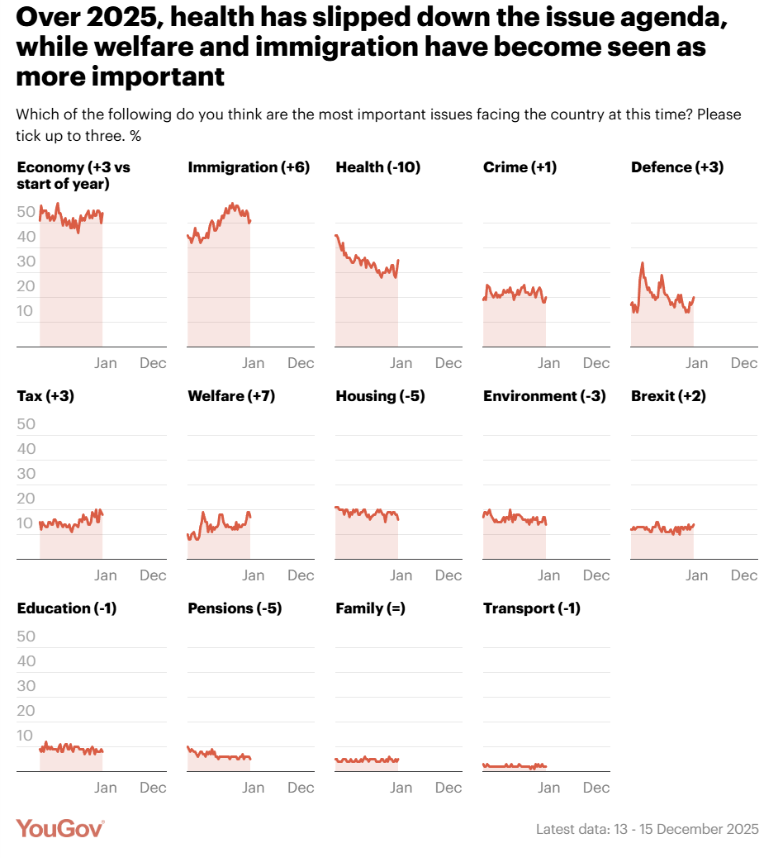
Source: YouGov plc, 2025, © All rights reserved
Internal Labour politics
Last year was not politically successful for the leadership of the Labour Party. Last January, Keir Starmer had a strong positive approval rating among 2024 Geneal Election Labour voters. Now, a majority of even these voters have an unfavourable rating of the leader they chose for No. 10. Speculation has been swirling in recent months of a potential leadership challenge – this will only increase following expected poor results in the May elections.
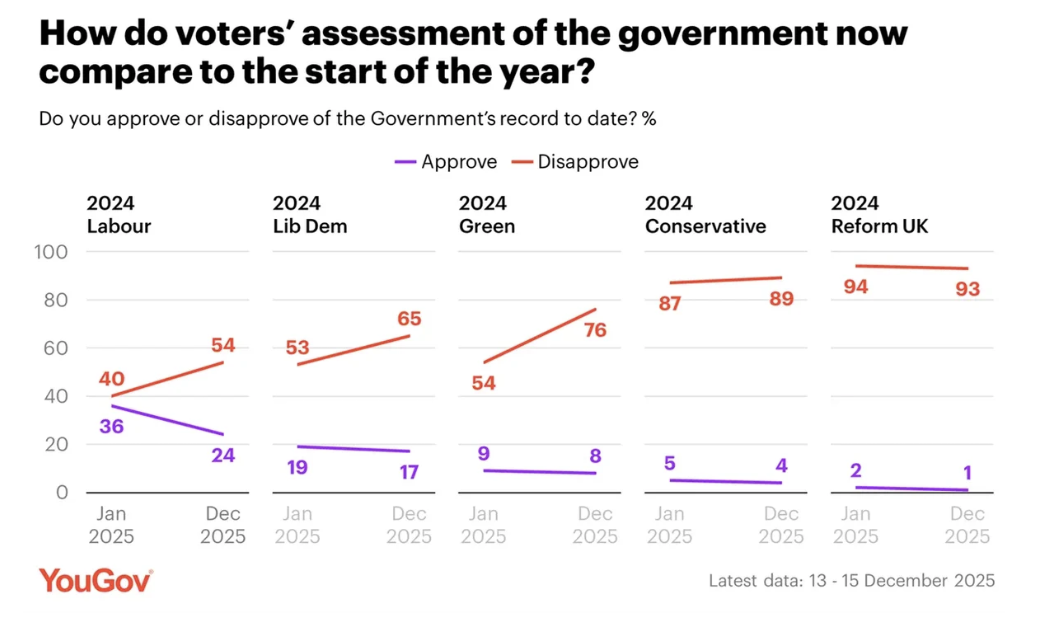
Source: YouGov plc, 2025, © All rights reserved
However, polling from YouGov and Sky News last month found that public attitudes to alternative leaders were mixed, with only Andy Burnham scoring a positive result in a poll asking who could run the country better than Starmer. Wes Streeting, Shabana Mahmood, Ed Miliband, and Angela Rayner all scored behind the Prime Minister, suggesting that a leadership change alone is unlikely to restore the Labour Party’s popularity.
In Parliament, contrary to expectations that Labour MPs would be loyal ‘Starmtroopers’, last year was marked by a collapse of parliamentary unity, with a big rebellion over welfare reforms forcing a Government U-turn. More than 120 Labour MPs signed a “reasoned amendment” which ultimately thwarted the government’s proposals. In 2026, the influence of backbench Labour MPs will likely continue to grow, making relationship building with Labour parliamentarians a necessity for organisations.
Conclusion
Overall, to speak persuasively to MPs and Ministers this year it will be vital to fully appreciate the challenges they face with an increasingly restless public, especially as many parts of the country head to the polls in May. The Government needs some short-term wins which may lead to challenges; for example, the Clean Power Mission has long-term benefits but will have to show further savings on people’s energy bills – and the Government is desperate to meet its housebuilding targets, even if this means some immediate harm to nature in specific development sites.
Ultimately, the strongest arguments will link environmental action to voters’ top concerns. And with the rise of new challenger parties, having your message taken up by political opponents of the Government could also help drive it up the agenda – if approached in the right strategic manner.
Seahorse are specialists in driving environmental and social impact with award-winning public affairs, strategy and PR, and have strong links across the environment sector and Parliament. Get in touch to discuss how we can support your organisation’s work in 2026.