
The revised Environmental Improvement Plan offers significant opportunities to engage on the Government’s green agenda
By Matthew Dawson, Senior Account Manager
The publication of the revised Environmental Improvement Plan (EIP) is a significant moment for the Labour Government. Ministers now have ownership of a plan which covers almost every aspect of policy relating to the natural environment; a plan which promises to be a “roadmap for restoring England’s environment over the coming years.”
For those working to influence policy, it offers a veritable cloakroom of hooks on which to hang campaign asks and hold the Government to account.
While there is plenty for environmentalists to welcome in the new plan, it comes against a challenging backdrop of unchanged fundamentals. As set out in the summer Spending Review and recent Budget, Defra still faces one of the steepest budget reductions across government over coming years, and nature is still facing the headwinds of increasingly extreme weather and pollution.
Background
The revision of the EIP was set in train before the last election when Wildlife and Countryside Link launched a legal challenge on the Government’s failure to consider a review of the EIP. Shortly after the Labour Government took office in July 2024 the review was announced and promised “by the end of the year”.
Since then it has been repeatedly delayed, with former Defra Secretary of State Steve Reed saying as far back as March that “we need to wait for the outcome of the Spending Review so I know what resources I can allocate to those delivery plans. I don't want to put something out in public that I'm not confident we can deliver.” It appears that the same logic then extended to the Autumn Budget, with the plan now published less than a week after the Chancellor set out her spending plans.
Content of new plan
The plan’s central framework is linked to the Environment Act 2021 statutory targets. These include the flagship commitment to “halt the decline in species populations by 2030”, the ‘net-zero’ equivalent for nature. The revised EIP also sets interim targets for longer-term targets. 2 of the interim targets are new (relating to wildlife-friendly farms and invasive species) and many are revised with new dates for their achievement, in many cases moving the date of completion from 2028 to 2030.
The EIP also contains 10 goals and provides an illustrative plan for how the Government intends to deliver them. The over-arching goal (Goal 1) is “restored nature”, with other goals including air, water chemicals, waste and resources.
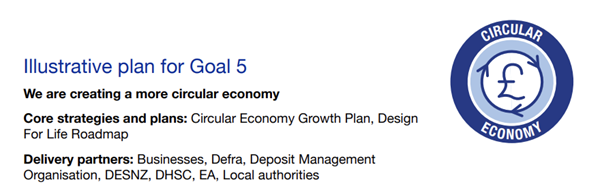
The plans for each of the goals make a welcome reference to the importance of cross-Government ‘delivery partners’ beyond Defra required to make them a success.
A notable and positive addition is the inclusion of fungi, the conservation of which was not referenced at all in the previous plan. The new commitment to conserve and recover “plants, animals and fungi” has been warmly welcomed by Seahorse client the Fungi Foundation and others.
Analysis
The EIP is undoubtedly an important moment for this Labour Government and a chance to reset the narrative around nature. LCEF’s Paul McNamee has hailed it as “a step-change in environmental ambition in this country – shifting nature recovery onto a genuinely strategic footing”.
It was launched by Emma Reynolds, who has has pledged to make Defra a “growth department”. While this hasn’t been renamed the Environmental Growth Plan (in line with the rebrand of the Circular Economy Strategy), it is peppered with references to how the natural world can boost growth. This includes a foreword which outlines how environmental failure “threatens more than our environment— it risks our nation’s economic resilience and security. In an era of supply chain disruption and conflict, protecting and restoring nature strengthens our resilience.”
While the EIP delivers a somewhat harmonious view of the natural environment and our economy, the tensions within the Government’s environmental rhetoric were on full display around the launch of the plan. On the same morning, Prime Minister Keir Starmer also spoke about his vision for economic renewal, criticizing “well-intentioned, but fundamentally misguided, environmental regulations” (in relation to John Fingleton’s report on the nuclear industry). This follows the Government’s Planning and Infrastructure Bill (now in its final stages in Parliament) which has been widely criticised by conservation groups as lacking safeguards for wildlife and habitats, and proposals to water down biodiversity net gain (BNG) requirements for smaller housebuilders.
Some commentators have also highlighted how current plan differs from the 2023 version in terms of Prime Ministerial support, noting that former Prime Minister Rishi Sunak provided the foreword to EIP23 in addition to the then Secretary of State for Defra. This matters because certain aspects of the plan require the backing of No10 ahead of the next King’s Speech to secure time for new primary legislation. For example, the proposed ban on the sale of peat-based products in the EIP is promised “when parliamentary time allows” and reforms to the water sector are also outlined with this caveat (with a new water reform bill expected following the next King’s Speech). Speculation is also rife over a potential Nature Bill announcement in the Spring which, if prioritised by Government, could deliver some of these vital legislative changes for nature.
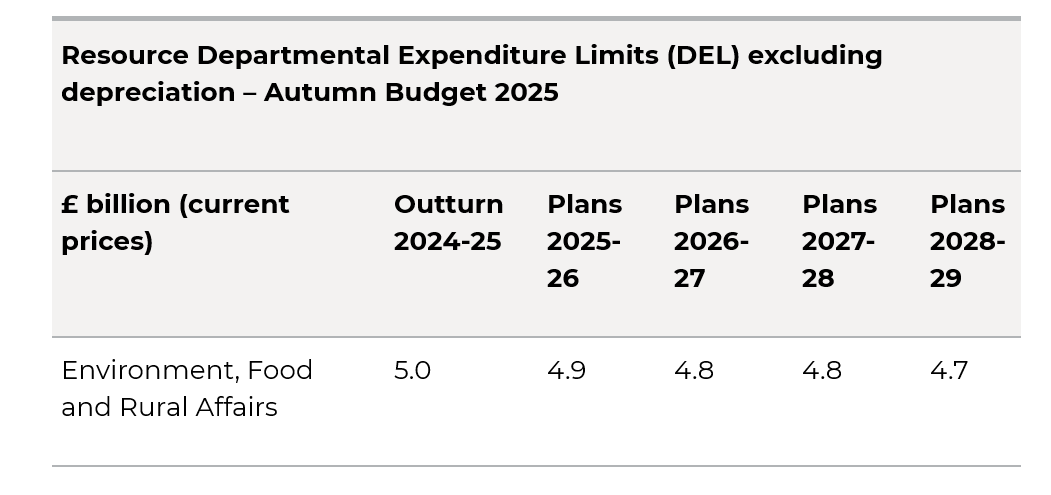
And it is worth noting that last week’s Autumn Budget reconfirmed that Defra has incredibly strained resources, see table above. With the number of officials having fallen significantly over recent years, and with still less money to spend, meeting existing targets and delivering any new or ambitious environmental agendas will be extremely difficult.
Conclusion
Overall, it is still debatable whether the revised document is more than the ‘shopping list’ of existing policies for which the previous EIP was often criticised. But it does present a chance to see in full the Government’s suite of environmental policies aimed at restoring the natural world. After months of wait, it is an important positive step for this often-embattled Government.